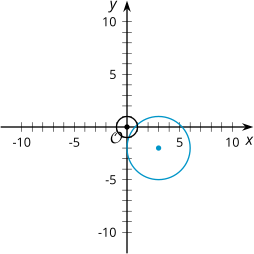
Derive the equation of a circle of given center and radius using the Pythagorean Theorem; complete the square to find the center and radius of a circle given by an equation.
This Math Talk focuses on rewriting quadratic expressions using perfect squares. It encourages students to think about expressions involving perfect squares and to rely on the structure of a squared binomial to mentally solve problems. The understanding elicited here will be helpful later in the lesson when students rewrite equations for a circle by completing the square.
To rewrite expressions with perfect squares in two variables, students need to look for and make use of structure (MP7).
Launch
Tell students to close their books or devices (or to keep them closed). Reveal one problem at a time. For each problem:
Give students quiet think time, and ask them to give a signal when they have an answer and a strategy.
Invite students to share their strategies, and record and display their responses for all to see.
Use the questions in the Activity Synthesis to involve more students in the conversation before moving to the next problem.
Keep all previous problems and work displayed throughout the talk.
Action and Expression: Internalize Executive Functions. To support working memory, provide students with sticky notes or mini whiteboards. Supports accessibility for: Memory, Organization
Activity
None
Student Task Statement
For each expression, mentally find an equivalent expression that uses perfect squares:
Activity Synthesis
The goal of this discussion is to review students’ strategies for completing the square with expressions in 2 variables.
To involve more students in the conversation, consider asking:
“Who can restate ’s reasoning in a different way?”
“Did anyone use the same strategy but would explain it differently?”
“Did anyone solve the problem in a different way?”
“Does anyone want to add on to ’s strategy?”
“Do you agree or disagree? Why?”
“What connections to previous problems do you see?”
MLR8 Discussion Supports. Display sentence frames to support students when they explain their strategy. Examples:
“First, I because .”
“I noticed , so I .”
Some students may benefit from the opportunity to rehearse what they will say with a partner before they share with the whole class. Advances: Speaking, Representing
The purpose of this discussion is for students to compare the transformations of a circle to the radius and center of the circle. Display this image of two circles for the discussion:
Ask students:
"What transformations take the original circle to Circle P?" (translate right 4 and up 3, dilate by a factor of 6)
"What are the center and radius of Circle P?" (The center is and the radius is 5.)
"How are the center and radius of the circle related to the transformations from the original circle?" (The center means that it has been translated horizontally by and translated vertically by . The radius of tells us that it has been dilated by a factor of .)
"How can you use this information to tell the transformations from the equation of the circle?" (The equation of a circle uses the center and radius. A circle with center and radius can be written , so we know the translations and scale factor as well.)
Student Lesson Summary
We can transform the graphs of circles in the coordinate plane using translations and dilations.
An original circle is centered at with a radius of 1. Its image is centered at with a radius of 3. What transformations were needed to get from the original to the image? In this case, there was a translation right 3 and down 2, with a dilation by a factor of 3. This makes sense because a translation of the circle will translate the center in the same way, and dilating the circle by a factor of 3 also dilates the radius by a factor of 3.
We can also see these transformations in the equations for the circles. We know from studying circles that the equation of any circle with center and radius can be written . Therefore, the original circle has an equation , and the image or transformed circle has an equation .
Since the translation of the circle can be determined using the centers, that means that the transformed circle has been translated horizontally by units and translated vertically by units. Since the radius of the transformed circle is the same as the scale factor of dilation, we can say that the transformed circle has been dilated by a factor of .
This means we can tell what transformations have been applied to a circle in the coordinate plane without graphing, given the original circle defined by . For example, if a circle has an equation , we can tell that it was translated right 12 units, translated down 8 units, and dilated by a factor of 9.
Have a correction or suggestion?
Tell us about a typo, a broken link, or an improvement you’d like to see. We read every submission but can’t reply.
Have a question or need support instead? Visit our Contact Us page to reach our team.
Student Response
Loading...
Building on Student Thinking
Materials
None
Activity Narrative
The purpose of this activity is for students to recall earlier work with graphing circles in the coordinate plane. They make connections between the equation for a circle and transformations of an equation and describe these connections precisely (MP6).
This activity uses the Collect and Display math language routine to advance conversing and reading as students clarify, build on, or make connections to mathematical language.
Launch
Arrange students in groups of 2–4. Listen for the language students use as they answer the second question.
Use Collect and Display to create a shared reference that captures students’ developing mathematical language. Collect the language that students use to describe the transformations, equation, and center of each circle. Display words and phrases, such as "the circle shifted left 1, and the center also is moved left 1," and "the circle was dilated, and the radius got bigger."
Activity
None
Student Task Statement
Match these equations of circles with their graphs and centers.
Equations:
Centers:
Graphs:
Circle A
Circle B
Circle C
Circle D
What do you notice about the equations and the coordinates of the center of each circle? How does this connect to what you know about transformations of functions?
An original equation for a circle could be . What would the new equation be for a circle that:
Has a center ?
Has a radius of 6?
Has a center with a radius of 5?
Student Response
Loading...
Building on Student Thinking
If students match the first equation to the center or Circle B instead of and Circle A, consider saying:
“Tell me more about how you matched your equation.”
“How could you check your matches to know you are correct?”
Activity Synthesis
The purpose of this discussion is for students to describe the connections between a transformation to the circle and the equation of a circle. Direct students’ attention to the reference created using Collect and Display. Ask students to share how the transformations connected to the equation and graphs. Invite students to borrow language from the display as needed. As they respond, update the reference to include additional phrases. (For example, the display may have “the circle was dilated and the radius got bigger” already on it and can be updated with the more precise phrase “the circle was dilated by a factor of 3 and the radius is 3 times as large.”)
Here are some questions for discussion:
"Where do you see the translations in the equation?" (The horizontal translation is what is subtracted from in the equation, and the vertical translation is what is subtracted from in the equation.)
"Where do you see the dilation in the equation?" (The factor of dilation is the same as the new radius, so it is the square root of the constant term after the equal sign.)
Materials
None
Activity Narrative
In this activity, students rewrite equations of circles and parabolas by completing the square. By examining equations of the form , students compare the structure of equations for both parabolas and circles (MP7). While the equation for a circle is not a function of , the transformation behavior is similar to the work students have done with transformations of parabolas and other functions.
Launch
None
Activity
None
Student Task Statement
Here are 2 equations:
Rewrite the equations so the transformations are visible by completing the square.
Which equation represents a circle? Which equation represents a parabola?
For the circle:
Identify the center and radius.
Describe the transformations from the original equation .
For the parabola:
Identify the vertex.
Describe the transformation from the original equation .
Student Response
Loading...
Building on Student Thinking
Activity Synthesis
The purpose of this discussion is for students to describe the effects of a transformation on the equation of a circle. Here are some questions for discussion:
“What transformations can you see from the equation of a circle?” (Horizontal and vertical translation, and dilation.)
“Where can you see these transformations in the equation?” (For an equation , the circle has a horizontal shift of , a vertical shift of , and a dilation by a factor of .)
“What parts of a circle do the horizontal and vertical translations and the dilation tell us about?” (The horizontal and vertical shifts give the center of the circle, and the dilation gives us the radius.)
Standards Alignment
Building On
Addressing
HSG-GPE.A
Translate between the geometric description and the equation for a conic section
Derive the equation of a circle of given center and radius using the Pythagorean Theorem; complete the square to find the center and radius of a circle given by an equation.
Identify the effect on the graph of replacing by , , , and for specific values of (both positive and negative); find the value of given the graphs. Experiment with cases and illustrate an explanation of the effects on the graph using technology. Include recognizing even and odd functions from their graphs and algebraic expressions for them.
Derive the equation of a circle of given center and radius using the Pythagorean Theorem; complete the square to find the center and radius of a circle given by an equation.